
All Guides
Horse Care Guide — Horses of Hoofprint Bay
Daily horse care in Horses of Hoofprint Bay: feeding, grooming, pasture, trait quirks, injuries, prevention, and when stablehands should take over chores.
Horse care in Horses of Hoofprint Bay is a daily rhythm, not a mini-game you finish once. Every round (one farm day) horses shift on hunger, thirst, cleanliness, confidence, and exercise. Skip steps and trust erodes; skip too long and competition horses lose the /guides/training-guide/ stats you built. This guide walks the full loop, how /horses/personality-traits/ change the workload, and when to hand chores to /farm/staff-guide/ grooms.
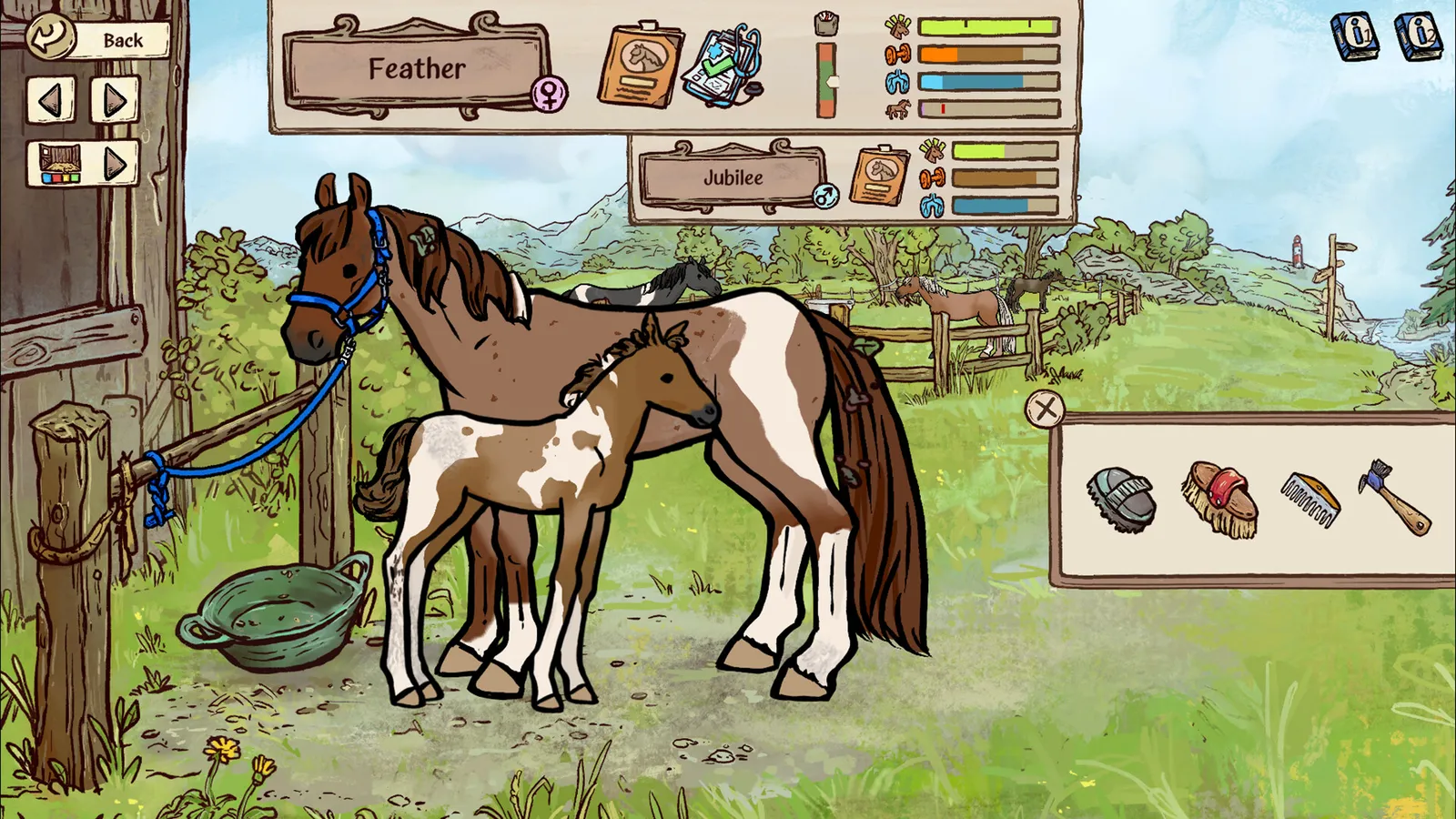
Screenshot: official Steam store page.
The daily care loop
Think in two layers: yard tasks for everyone in a stable group, then individual care horse by horse.
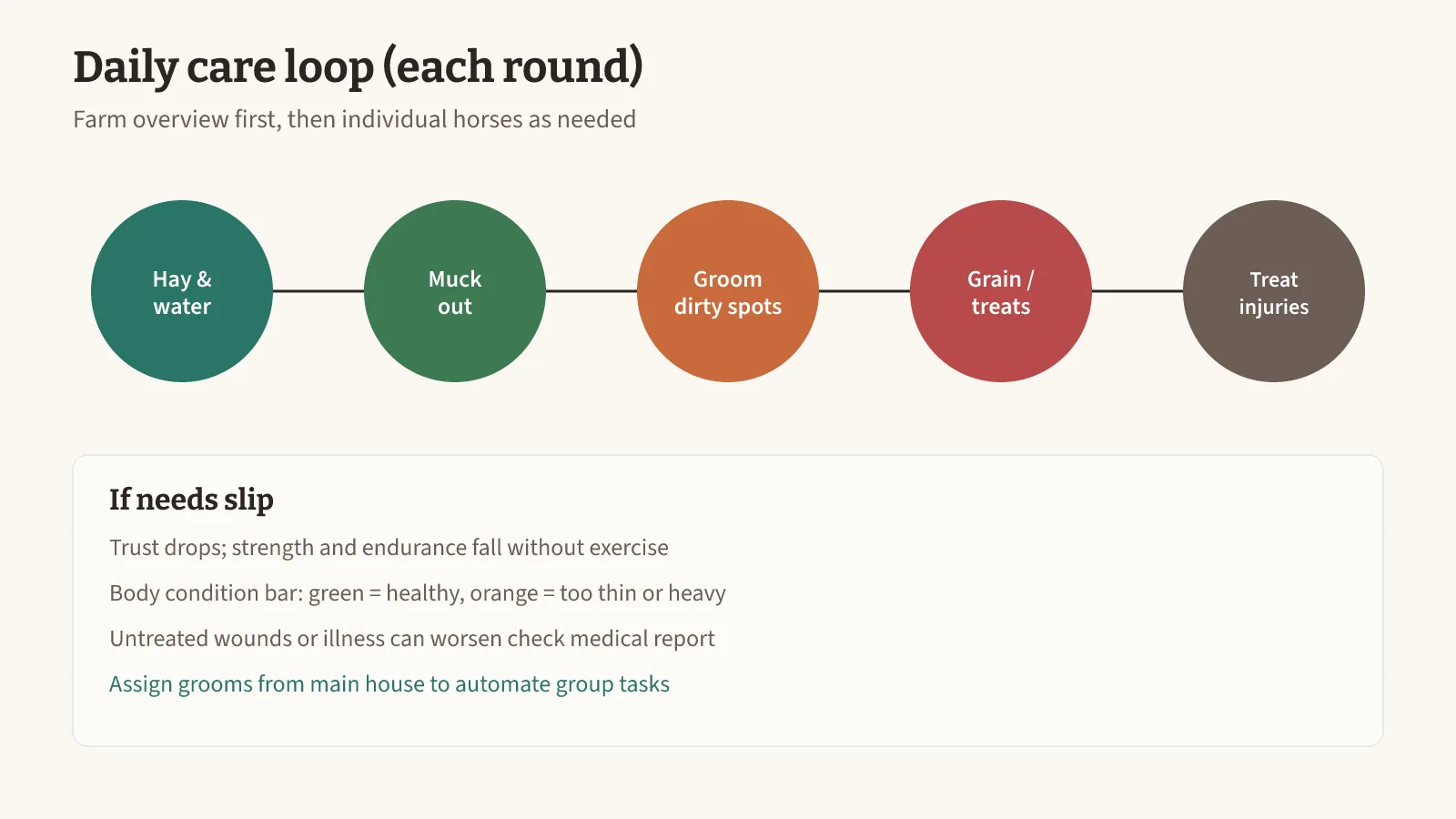
Yard layer (farm overview)
From the farm map you:
- Place hay and water for each stable group.
- Muck out shared spaces.
These steps affect every horse in the group. Thirst appears when water is missing even though there is no separate thirst bar in community documentation—watch behavior and overview prompts.
Pasture turnout (see /farm/building-upgrade-order/) can supplement exercise and, according to comparison articles, may reduce hay consumption when gates are open—reported economy detail, not a substitute for checking stock.
Individual layer (horse care screen)
Open a horse from the stable list to:
- Groom by dragging the correct brush over mud, leaves, or roughed-up coat areas.
- Feed grain into the bowl and treats to the mouth for confidence bumps.
- Treat wounds by dragging the right pharmacy item onto the injury.
- Assign staff, tack, and destinations (arena, trails, lessons).
The Steam store page highlights realistic grooming and hoof care to prevent saddle sores and abscesses—high-level design intent that matches wound types listed in community wikis.
Feeding and body condition
Body condition uses a bar with a green healthy band and orange zones above and below (grindnstrat + TMQ agree):
| Zone | Meaning | Action |
|---|---|---|
| Green | Healthy weight | Maintain hay plus trait-appropriate grain |
| Lower orange | Getting hungry | Add hay/grain before malnutrition |
| Upper orange | Overweight | Cut extras; exercise lowers condition overnight |
Overnight time and exercise lower condition; feeding raises it. Several days below green can lead to malnutrition, a visible welfare state with prestige risk.
Grain is per horse, which is where traits matter. Check the full trait list on /horses/personality-traits/; for care planning remember:
- Hard Keeper — budget more grain time or groom skill that feeds correctly.
- Easy Keeper — lighter grain; easier to overweight if you treat every horse the same.
Grooming, mud, and competition readiness
Cleanliness is visual: dirt patches on coat, mane, tail, and hooves rather than a numeric bar. Brushing removes the patches you see.
- Neat Freak horses stay cleaner longer—less brush time.
- Mud Lover horses get dirty faster, especially with pasture access.
Dirty horses hurt prestige if you enter competitions underturned out (noted in grindnstrat prestige section). Boarders with full-service contracts also expect grooming (/farm/boarders-and-lessons/).
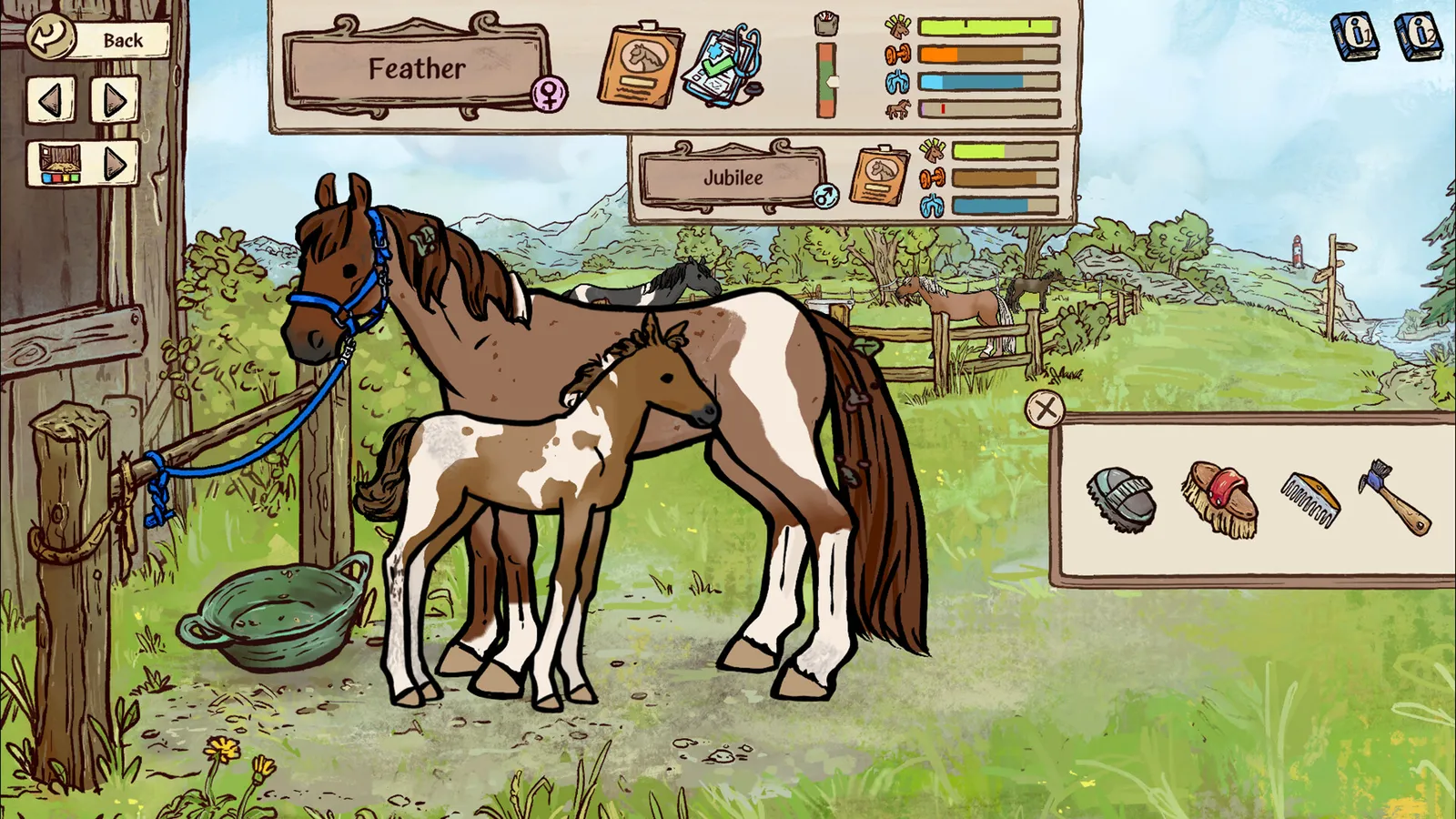
Confidence and trust (care angle)
Confidence is a green bar tied to riding behavior in /guides/training-guide/, but daily care feeds it too:
- Find the horse’s favorite scritch spot (unique per horse).
- Give treats (trait Snacky boosts this).
- Run confidence training in the arena when care alone plateaus.
Each method has a daily cap. Care can raise confidence up to the second marker; only training pushes higher according to community stat guides.
Low confidence horses look away, spook on trails, and fight gait changes—care time is competition prep, not fluff.
Exercise and rest
The exercise (stamina) bar sets how much training fits in one round. Training past the red warning exhausts the horse next day, wasting feed and grooming you just paid for.
Balance:
- Arena work and trails raise strength/endurance (training guide territory).
- Walking, free lunging, and confidence courses add exercise without the same stat grind.
If exercise is low, do light work before accepting schooling boarders or lesson assignments that drain stats.
Injuries, illness, and prevention
Hoofprint Bay tracks specific conditions instead of one HP bar (TMQ comparison vs other barn sims). Common entries in community lists:
- Cuts and infected cuts, abrasions, lameness, saddle sores, tendon injuries.
- Hoof problems such as thrush or abscesses.
- Systemic issues like laminitis tied to nutrition.
Prevention habits:
- Groom and pick hooves before saddling (Steam emphasizes hoof care).
- Avoid jumping when strength warnings flash—falls cause wounds and confidence loss.
- Treat promptly with house pharmacy items; escalate to the vet when guides flag serious cases.
Untreated problems can worsen (grindnstrat + TMQ). Welfare investigations trigger if illness or malnutrition persists—overlapping with boarder contract failures.
Read the in-game library books Injuries & Illnesses and Traits and Quirks for authoritative flavor text; wiki summaries are not substitutes for those entries.
How stablehands share the workload
You never automate player riding, but you can automate much of care via grooms from the /farm/staff-guide/:
- Assign horses or groups to Laura, Fiete, or Lucas depending on main-house tier.
- Grooms handle feeding (with correct grain amounts per staff notes), mucking, and grooming within their capacity.
Trainers and lesson staff do not replace hay placement for untouched groups—plan which chores stay manual until you upgrade house and staff.
Care-first starter routine
For your first weeks with one mare (/horses/starter-mare-guide/):
- Yard hay, water, muck.
- Groom, check medical report, scritch to daily cap.
- Feed grain only if body condition dips or trait demands it.
- Train or trail if exercise allows.
- Expand routines before accepting boarders or lesson grinds.
When chores beat training for three rounds straight, read /farm/building-upgrade-order/ for stable sizing and hire your first groom.
Sources and verification
Compiled 2026-11-05 from the Steam store page, grindnstrat guide, TMQ HoHB wiki, and TMQ comparison. Items marked “reported” come from community guides and were not independently confirmed in-game.
Dual-sourced: group vs individual feeding, body condition colors, visible dirt, trait care effects listed above, worsening untreated injuries, groom tasks. Single-source: exact daily confidence caps per method, pasture hay savings magnitude, office activity UI name.
FAQ
Do you feed each horse individually in Hoofprint Bay?
What happens if you skip care for several days?
How does grooming work?
Which traits affect daily care?
Can injuries get worse if untreated?
How do stablehands help with care?
Related Articles
competitions
Caprilli Guide — Horses of Hoofprint Bay
Caprilli in Horses of Hoofprint Bay: what the test checks, how to unlock and enter, scoring basics, and prep low-stat horses before show jumping.
competitions
Medium Show Jumping Guide — Horses of Hoofprint Bay
Win Novice (medium) show jumping in Horses of Hoofprint Bay: prep checklist, jump assist limits, strength training, and timing fixes for the post-Beginner wall.
competitions
Show Jumping Guide — Horses of Hoofprint Bay
Show jumping in Horses of Hoofprint Bay: town entry, licenses, levels, jump timing, strength tips, and common faults—clear Beginner before chasing Novice.
Was this helpful?
Thanks for the feedback!